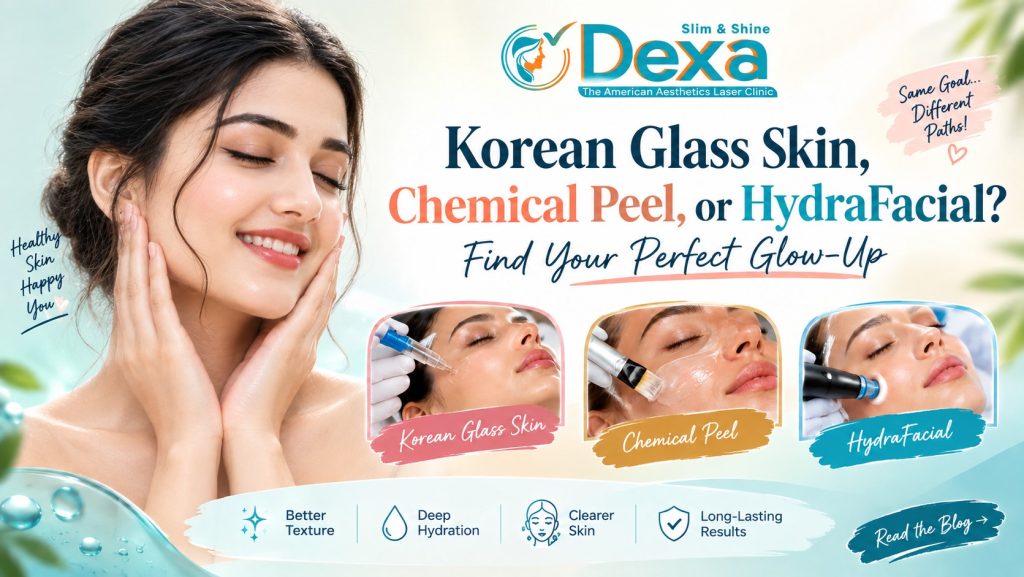
Korean Glass Skin, Chemical Peel, or HydraFacial: Find Your Perfect Glow-Up
You’ve probably scrolled through dozens of before-and-after posts by now – someone’s skin looks poreless, someone else’s looks freshly “reset,” and you’re left wondering which treatment actually gave them that result. When you start researching, three names keep showing up everywhere: Korean glass skin treatment, chemical peel, and HydraFacial. Most online articles compare only two at a time, which leaves you doing half the research yourself. This guide breaks down all three together, so by the end, you’ll know exactly which one fits your skin, your concern, and your lifestyle, not just which one is trending this month.
What Each Treatment Actually Is
Before you can decide between Korean glass skin treatment, chemical peel, or HydraFacial, it helps to understand what’s actually happening to your skin during each one. They may all promise “glowing skin,” but the mechanism behind each is completely different, and that difference is exactly why one might suit you far better than the other two.
Korean Glass Skin Treatment
Korean glass skin treatment isn’t one single step – it’s a multi-step protocol built around the K-beauty philosophy of smooth, hydrated, light-reflective skin, often described in Korean as “yuri pibu.” Rather than relying on aggressive exfoliation, the treatment layers medical-grade hydrating actives, skin boosters, and barrier-repair ingredients in sequence to optimise how much water your skin retains at a deeper level. The goal isn’t a one-time shine – it’s building your skin’s ability to hold hydration and reflect light more evenly over a series of sessions. If you’re comparing glass skin vs. HydraFacial, the biggest distinction is this: glass skin treatment is a layered program, while HydraFacial is a single-session device treatment.
Chemical Peel
A chemical peel uses a controlled acid solution – typically glycolic or lactic acid (AHAs), salicylic acid (a BHA), or trichloroacetic acid (TCA) for deeper correction – to remove the damaged outer layer of skin. Superficial peels using AHAs or BHAs are gentle, well-tolerated, and involve virtually no downtime, while medium-depth TCA peels penetrate further, triggering more visible renewal along with a longer recovery window. Salicylic acid peels, being oil-soluble, are particularly suited to acne-prone and oily skin, while glycolic acid is often the starting point for people wanting to fade dullness and mild pigmentation.
HydraFacial
HydraFacial is a device-based facial that runs on patented Vortex-Fusion technology. A spiral-tipped handpiece uses vacuum suction to cleanse, gently exfoliate, and painlessly extract debris from your pores, then switches to infuse the same pores with hydrating serums – all in roughly 30 minutes, with zero downtime. It’s this single-session, walk-in-walk-out-glowing nature that makes hydrafacial one of the most searched options when people ask “chemical peel vs hydrafacial which is better” before an event.
Side-by-Side Comparison Table
Here’s how the three stack up when placed next to each other – the comparison most blogs skip because they only ever look at two treatments at once.
| Factor | Korean Glass Skin | Chemical Peel | HydraFacial |
|---|---|---|---|
| Primary Goal | Overall hydration, glow, texture, barrier repair | Resurfacing, pigmentation, texture correction | Deep cleansing, extraction, instant hydration |
| Mechanism | Layered hydration + skin boosters | Controlled acid exfoliation | Vacuum extraction + serum infusion |
| Downtime | Minimal, protocol-dependent | None to 5–7 days, depending on peel strength | None |
| Sensation | Generally comfortable | Mild tingling to warmth (stronger with TCA) | Painless suction, no stinging |
| Results Timeline | Builds across a session series | Visible within days to weeks as skin renews | Visible immediately after one session |
| Session Structure | Structured program | Often sold as a course (4–6 sessions for light peels) | Single session or ongoing maintenance plan |
How Many Sessions & How Long to See Results
This is the part most competitor blogs gloss over – and it’s usually the first question you actually want answered.
For HydraFacial, a single session gives an immediate, visible glow, but that glow typically lasts around 5 to 7 days. For lasting improvement in texture, hydration, or pigmentation, most skin professionals recommend a maintenance schedule of once every 4 to 6 weeks, with acne-prone skin sometimes needing sessions every 2 to 3 weeks initially, before easing into a monthly rhythm.
For chemical peel treatment, light AHA/BHA peels are usually done in a series of 4 to 6 sessions spaced 1 to 2 weeks apart, with visible improvement continuing for 2 to 3 months after the series ends. Medium-depth TCA peels work differently – usually just 1 to 3 sessions are needed, but each comes with 5 to 7 days of visible peeling, with results continuing to improve for 3 to 6 months as collagen remodels underneath.
For Korean glass skin treatment, because it’s a layered protocol rather than a single mechanism, your practitioner will typically plan a structured series of sessions, with hydration and texture improvements building progressively rather than appearing after one visit. This is precisely why glass skin treatment cost is usually structured as a package or program rather than charged as a single line item – you’re paying for a plan, not a one-off procedure.
Which One Should You Choose
There isn’t a universal “best” among these three – the right pick depends entirely on what your skin actually needs right now, and how much downtime you’re realistically willing to work around.
Choose Korean Glass Skin Treatment If
Your main concern is that your skin looks tired, dull, or dehydrated overall, rather than one specific problem area. If you’re chasing the best facial for glowing skin with a program-based, cumulative approach rather than a quick single fix, glass skin treatment is built exactly for that.
Choose Chemical Peel If
You’re dealing with a specific concern – acne marks, mild pigmentation, rough texture, or sun-related dullness – and you’re comfortable with some downtime depending on peel strength. Chemical peel treatment tends to work at a deeper level than a HydraFacial, which is why it’s often the better answer for skin treatment for dull skin caused by buildup and uneven tone rather than dehydration alone.
Choose HydraFacial If
You need visible results with zero downtime – before a wedding, an important meeting, or a flight — or your primary concern is congested pores and general dehydration. It also works well as a maintenance step between more intensive treatments.
Can They Be Combined / Sequenced
Yes, and in practice, this is how most experienced clinics actually plan treatment. HydraFacial is often used to prep and hydrate the skin, while chemical peels handle deeper resurfacing – and Korean glass skin protocols frequently incorporate elements of both hydration-based and gentle exfoliation-based steps within their sequence. Rather than picking one treatment forever, your practitioner will usually build a plan that layers these based on how your skin responds over time, which is exactly the kind of decision that benefits from a real consultation instead of guesswork.
Conclusion
At the end of the day, the “glass skin vs hydrafacial vs chemical peel” debate isn’t really about which treatment is objectively superior – it’s about which one matches your skin’s current concern, your downtime tolerance, and your longer-term goals. Dullness and dehydration lean toward glass skin. Specific pigmentation or texture issues lean toward a peel. Instant, event-ready glow leans toward HydraFacial. If you’re still unsure, the simplest next step is a proper skin consultation rather than picking a treatment off a trending list. You can explore all three treatments at Dexa, guided by Dr. Ranjeeta Kashyap and the clinic’s aesthetic team, to figure out exactly which approach – or combination – is right for your skin.
FAQ
Yes, when matched to your skin type and concern. Light AHA/BHA peels are well-tolerated and effectively improve texture, dullness, and mild pigmentation, while stronger TCA peels are reserved for deeper correction under professional supervision.
Most people describe light peels as a mild tingling or warm sensation rather than pain. Medium-depth TCA peels can feel more intense during application, but the procedure is controlled and monitored by a trained practitioner throughout.
No treatment is permanent, but results from Korean glass skin treatment last longer when you follow your doctor’s aftercare guidelines – consistent hydration, sun protection, and maintenance sessions all help sustain the glow well beyond the initial program.
HydraFacial can help improve superficial dullness and even out surface tone through exfoliation and hydration, but it isn’t a dedicated tan-removal treatment – deeper pigmentation concerns are usually better addressed with a chemical peel or a combination plan.
It cleanses, gently exfoliates, painlessly extracts debris from your pores, and infuses hydrating serums – all in one session, using vacuum-based Vortex-Fusion technology, with no downtime afterward.
It depends on the treatment: HydraFacial is often done monthly for maintenance, light chemical peels are typically done in a series of 4 to 6 sessions, and Korean glass skin protocols are planned as a structured program based on your skin’s starting point.
Glass skin treatment is usually priced as a program or package rather than a single session, since it’s built around a series of sessions. The exact cost depends on your skin’s condition and the protocol your practitioner recommends, so it’s best confirmed during a consultation.
HydraFacial is often a lower per-session cost but needs ongoing monthly visits to maintain results. Chemical peels are usually sold as a shorter series with longer-lasting improvement. Glass skin protocols are structured as a program, so cost is spread across a planned course rather than one-off visits.